
What Seventy People Knew
Why the only advantage left is the one nobody can sell you, and why most organizations spend it every eighteen months.
We were given three months.
Sprint's new chief marketing officer arrived in September and did not spend long softening what he had come to do. The roster went. The lead creative agency was dismissed without a review. The media account left us and was consolidated elsewhere. All of it settled by December, a striking pace for a decision about a business that size.
Sprint was my account. When it went, more than seventy people at Mindshare lost their jobs, and in the end, I was one of them.
He was out himself within three years. The announcement said retirement, a word our industry uses with tremendous generosity.
I have carried that sequence around for years. I am not going to argue the man had no right to want his own agencies. New leaders replace things; that is most of what a mandate is for, and anyone who has run a business has done a version of it.
What has stayed with me is the arithmetic: three months to take it apart, under three years in the chair, and what he dismantled had taken far longer than both combined to build.
What Sprint bought back, in exchange for three months of notice, was capability. Planners, strategists, buyers, a process, the ability to get a national campaign into market. All of it real, and all available from a dozen other firms by the end of the quarter. He was never going to have trouble replacing those agencies; there were many more lining up.
What left the building was different. Seventy people walked out knowing which of the previous year's wins had been earned and which ones had been luck. They knew which retail partner would move if you called on a Friday and which one would say yes and then quietly do nothing. They knew the argument the brand had already lost twice and why it lost. None of that was written down anywhere, because that kind of knowledge never is. It lives in people, it accrues slowly, and it can be destroyed in an afternoon by a man who is not going to be there long enough to miss it.
WHAT A MAGNUM TAUGHT ME ABOUT TIME
I learned wine from an Italian restaurateur, which is the one part of that marriage I have never had to reconsider. We drank Super Tuscans, mostly, because that was his world and I was in my twenties and glad to be told what was good. On my own, I also drank Pinot Noir, a great deal of it, out of California, Oregon, and Washington.
So, I did not think I was ignorant about American wine. I thought I had Napa filed: Cabernet Sauvignon, that was the category, and that was the sentence.
Then we were gifted a magnum of 1984 Opus One for our anniversary. We took it to the Prince of Wales Grill at the Hotel del Coronado, where the sommelier opened it and decanted it for us, and my tidy little sentence fell apart. A Bordeaux blend, grown in California, made by a Mondavi and a Rothschild who had decided to put two houses together. I had been holding a confident opinion about an entire region on very little evidence, which was humbling, and which I would like to say was the last time I did that.
What I could not get past was what had to exist behind it. A family in Bordeaux with two centuries behind it, and a man in Napa who had spent decades persuading the world his valley was serious. Two long accumulations, joined. Hand either a bigger budget in 1979, and you do not get a shorter route.
I have been drinking wine seriously for thirty years and have taken my WSET Level One, the qualification they hand people who are beginning. My friends find this hilarious. I intend to keep going anyway, slowly, in the gaps between everything else, because there is no version of this where I wake up knowing it. There is only the reading, the tasting, and being wrong about a glass in front of somebody who is not.
WHAT WALKED UP THE HILL
I was in Napa last week with people who collect properly. The host set a 1988 bottle from Spring Mountain beside a 2023 from the same mountain, and I do not know a faster way to explain what I mean. Thirty-five years apart, the same slope, and the place legible in both glasses. Either bottle can be bought tomorrow by anyone with the money, which is not true of the thirty-five years between them.
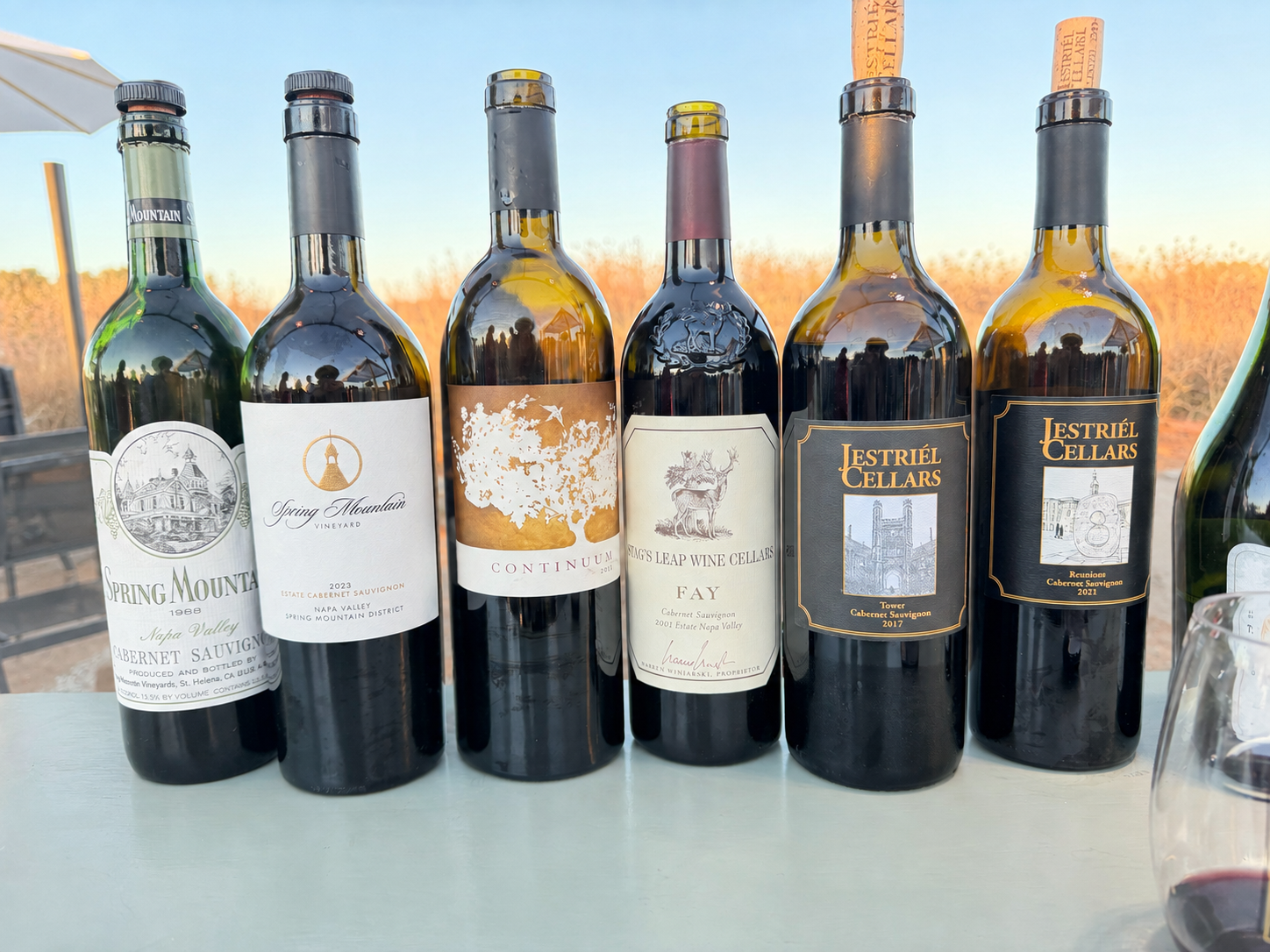
Spring Mountain and Continuum. Thirty-five years apart, the same slope.
Then a Continuum bottle was opened, and I have not put it down since, which has little to do with how it drank, though it drank beautifully.
In 2005 I made my first trip to Bordeaux, alone, with a folder of appointments I had spent months assembling. Mouton Rothschild among them. I was extremely pleased with myself.
The first night I ate alone in the dining room and ordered, and I am not going to apologize for this, most of the menu. Those who know, know what I am talking about. I began with Champagne, which is how a person should begin, and worked through the wines slowly, with nobody to talk to and no reason to hurry.
Another guest arrived that evening and watched me do it. A Spaniard who had driven up over the border that day in a Porsche Cayenne.
He asked the Maître d' who I was. I remember the pair of them glancing across at me and talking, in the manner of people who believe they are being discreet and are not.
We had not exchanged a word at that point, so I can only think it was the ordering. A woman on her own, obviously delighted, taking the food and the wine seriously. We talked afterwards, and by the end of the night we had agreed to spend the week together. I had the reservations, and he had the car, which suited us both.
I had no idea who he was. None whatsoever.
I found out two years later, in 2007, when my boss mentioned elBulli and I went and read about it that same afternoon. He was Ferran Adrià. elBulli had been named the best restaurant in the world in 2002 and held the title again that year, and I had spent three days in Bordeaux thinking of him as the Spaniard with the Cayenne, who had also, on the first night, watched me order most of a menu. I am putting this in print so my friends in the food world can enjoy it properly.
If you have seen Last Holiday, you know the scene. Queen Latifah alone at a grand hotel, eating her way down the menu until the chef comes out of his kitchen to meet the woman doing it. That film opened the January after my trip, which is the only reason I cannot claim it was based on me. In my version, the chef never had to leave the kitchen. He was already across the dining room, on holiday, asking the maître d' the same question.
He never corrected me, and I have come to think that was the point. A man recognized in every serious dining room in Europe had stumbled into three days of company who did not recognize him at all, and he was in no rush to change that. He wanted anonymity, and I think that is exactly why he enjoyed my company. It is the only time I have watched somebody set aside the thing they had spent twenty years building and enjoy the lightness of it.
The wine merchant in town knew exactly who he was. He owned the shop, which is the only reason any of it could happen, because a man who owns his shop can shut it on a Tuesday and spend three days driving two strangers around Bordeaux.
On one of the evenings together, he took us to the local bar in Saint-Émilion where the winemakers drink, which is not a tasting room and was not on anybody's itinerary, including mine. Nobody finds that room on their own; somebody has to take you.
One of the Moueix was there, from the family long associated with Pétrus, and our friend introduced us. He was young then and not yet running anything. His father still had the house, and nobody in that bar thought the arrangement worth remarking on, because on the right bank what a family knows tends to move down the table rather than out of the building.
I have thought about that evening since. I had the money and the itinerary. Ferran had a reputation and a fame I could not see. The merchant, our new friend, had neither, and he was the only one of us who could open that particular door, because he had stood in one place long enough to know everybody worth knowing.
Ferran had worked this out long before I did. On the first night, wanting to know who the woman at the corner table was, he did not consult anything. He asked the maître d'.
The introduction did not arrive through a budget, an agency, or a title. Both times that week, the answer came from somebody who had been standing in the same place long enough for it to count.
Napa did it the other way.
The Mondavi family sold the Robert Mondavi Winery in 2004. The estate's own telling of that period is blunter than anything I would risk writing about a client: the family was compelled to sell because the long-horizon, serious winemaking requires could not be reconciled with the quarterly demands of a publicly traded company. The buyer got the name, the buildings, the inventory, the distribution, the brand, the whole balance sheet.
What it could not buy left the property. Tim and Marcia Mondavi began the following year again on a ridge above the eastern side of the valley and called it Continuum, which is not a subtle name and was never intended to be.
Everything transferable went to the buyer. What had accrued walked up a hill and planted itself again.
THE CAPABILITY TRADE IS OVER
For most of my career an organization could hold a real lead in capability, because acquiring it was slow and expensive and most competitors could not be bothered. That lead is gone. Whatever your team spent four years building is now a subscription, and your competitor can be running it before lunch.
We buy those tools at Optima IQ™ and I would not give them back. Anyone romantic about the old friction is welcome to re-key a media plan by hand. But nobody has ever defended a subscription. You renew it, the way you renew the insurance, and that leaves the question now at the top of every annual plan I write: what does this organization have that could not have been bought this quarter?
THE ANSWER HAS NAMES IN IT
Mine does, anyway.
Marilyn Wagner was my client at Verizon. Liliana Grip was my client at Wells Fargo. Gary Schechner was my client at British Petroleum. Some of them I have known for the better part of twenty-five years, and the reason they are in my life has nothing to do with anything I could put on a capabilities slide. I did something useful for them once, under pressure, when it was not convenient, and neither of us has forgotten it.
None of that came out of a relationship strategy. It was a deposit made years ago that has been quietly earning ever since.
Every organization has a handful, and almost none appear on a balance sheet, which is why they go first when somebody needs a number to improve. Those are the senior people, and they cost what they cost because they remember what happened and because a client will still pick up the phone for them.
WE ARE BUILT TO MAKE WITHDRAWALS
Here is what worries me more than any model does. Compound interest is defeated by withdrawals far more often than by a poor rate of return.
The ordinary life of a large marketing organization runs like this. A reorganization every eighteen months. An agency review every three years, because procurement believes in review. A new chief marketing officer, whose average tenure is a little over three years, arriving with a need to make the thing hers. A platform migration. A rebrand. And every so often, somebody new with a mandate and a ninety-day clock.
Each is defensible, and several are necessary. Together they are a withdrawal schedule, which is how a company ends up with forty years of history and eighteen months of memory.
We have all sat in the kickoff. New team, new positioning, new roster, and someone says "fresh start" as though that were an achievement rather than a confession that the last four years failed to add up to anything.
I should be honest about which side of that ledger I have sat on. When I arrived at Mindshare to run Sprint, I rebuilt: restructured the team, wrote a new framework, stood up a digital division. It cost me a long run of two and three in the morning and a great many airports. It also cost people. Some could not adjust to what the job had become; new ones came in, and I decided which was which. I do not think I was wrong. I am also aware that I was making withdrawals, and that some of what left with them I did not know we had. The team I built that way is the team that got three months' notice.
Give that five more years, in a market where every capability is available to everyone at once, and the arithmetic turns bleak. You reach parity on everything you rent, you own nothing, and you compete on price, because price is what is left when nothing about you has had time to become distinctive. No dashboard flags this. Dashboards report the quarter, and this is a loss that appears in the decade.
THE AUDIT
Hesiod, farming and complaining about it three thousand years ago, wrote that if you put a little upon a little, and do this often, soon it will be a great deal. I like him for two reasons. He was talking about a grain pile rather than a career, and he had the honesty to put the difficult half in the sentence. Not a little upon a little. And do this often. Every organization I have worked in could manage the first part.
So, one question, asked in a room where people are obliged to answer.
At your next planning meeting, ask what we got better at this year that a competitor could not have written a check for.
Then stop talking and let the silence work.
If the honest answer is nothing, that was not a slow year; it was an expensive one, and the bill arrives later, made out to somebody who has not started yet.
We keep saying the tools amplify and the people decide, then skip the second half of our own sentence, which is that people are only worth amplifying if somebody lets them accumulate. Growth is Our Discipline™, and in this case the discipline is mostly restraint: knowing what took years to earn and refusing to trade it for one good quarter.
Seventy of us learned the price of that in three months. I have never been convinced the man who signed the order ever knew it had a price.
Perspectives by Ingrid Reyes, Founder & CEO, Optima IQ
The personal version of this argument, what compounds in a career and what quietly does not, is in The Reinvention Project, our publication for people in transition. Issue Five, "Compound the Human," arrives Saturday.